
Zapata Footprint: Difference between revisions
No edit summary |
pics and links |
||
| Line 1: | Line 1: | ||
The '''Zapata Track''' or '''New Mexico Track''' is an alleged fossilized human footprint discovered in New Mexico, sparking debate among creationists and skeptics alike over its authenticity and implications for the timeline of human history. | |||
==Quick Facts== | ==Quick Facts== | ||
{| class="wikitable" | {| class="wikitable" | ||
| Line 17: | Line 19: | ||
| Unknown | | Unknown | ||
|} | |} | ||
== Controversial Evidence or Misinterpreted Artifact? == | == Controversial Evidence or Misinterpreted Artifact? == | ||
The Zapata Footprint, also referred to as the | The Zapata Footprint, also referred to as the Zapata Track, has stirred debate and intrigue among creationists, proponents of out-of-place artifacts (OOPArts), and skeptics alike. This footprint-shaped impression, reportedly found in New Mexico, has raised questions about the possibility of human-like beings existing in prehistoric times, challenging the mainstream scientific timeline that places humans only within the last several hundred thousand years. However, the lack of scientific verification, along with inconsistencies in its documentation, has left many experts doubtful of its authenticity. | ||
https://thepeoplesvoice.tv/wp-content/uploads/2017/05/zapata.jpg | https://thepeoplesvoice.tv/wp-content/uploads/2017/05/zapata.jpg | ||
| Line 76: | Line 73: | ||
== References == | == References == | ||
[https://www.footprintsinstone.com/the-footprints/zapata-footprint/ Footprints in Stone - The Zapata Footprint] | |||
[[Category:OOPArts]] | [[Category:OOPArts]] | ||
[[Category:Human Remains]] | [[Category:Human Remains]] | ||
Revision as of 07:08, 3 November 2024
The Zapata Track or New Mexico Track is an alleged fossilized human footprint discovered in New Mexico, sparking debate among creationists and skeptics alike over its authenticity and implications for the timeline of human history.
Quick Facts
| Location Found: | New Mexico |
| Discovery Date: | 1929 |
| Current Location: | New Mexico |
| Authenticity: | Confirmed |
| Open to the Public: | Unknown |
Controversial Evidence or Misinterpreted Artifact?
The Zapata Footprint, also referred to as the Zapata Track, has stirred debate and intrigue among creationists, proponents of out-of-place artifacts (OOPArts), and skeptics alike. This footprint-shaped impression, reportedly found in New Mexico, has raised questions about the possibility of human-like beings existing in prehistoric times, challenging the mainstream scientific timeline that places humans only within the last several hundred thousand years. However, the lack of scientific verification, along with inconsistencies in its documentation, has left many experts doubtful of its authenticity.
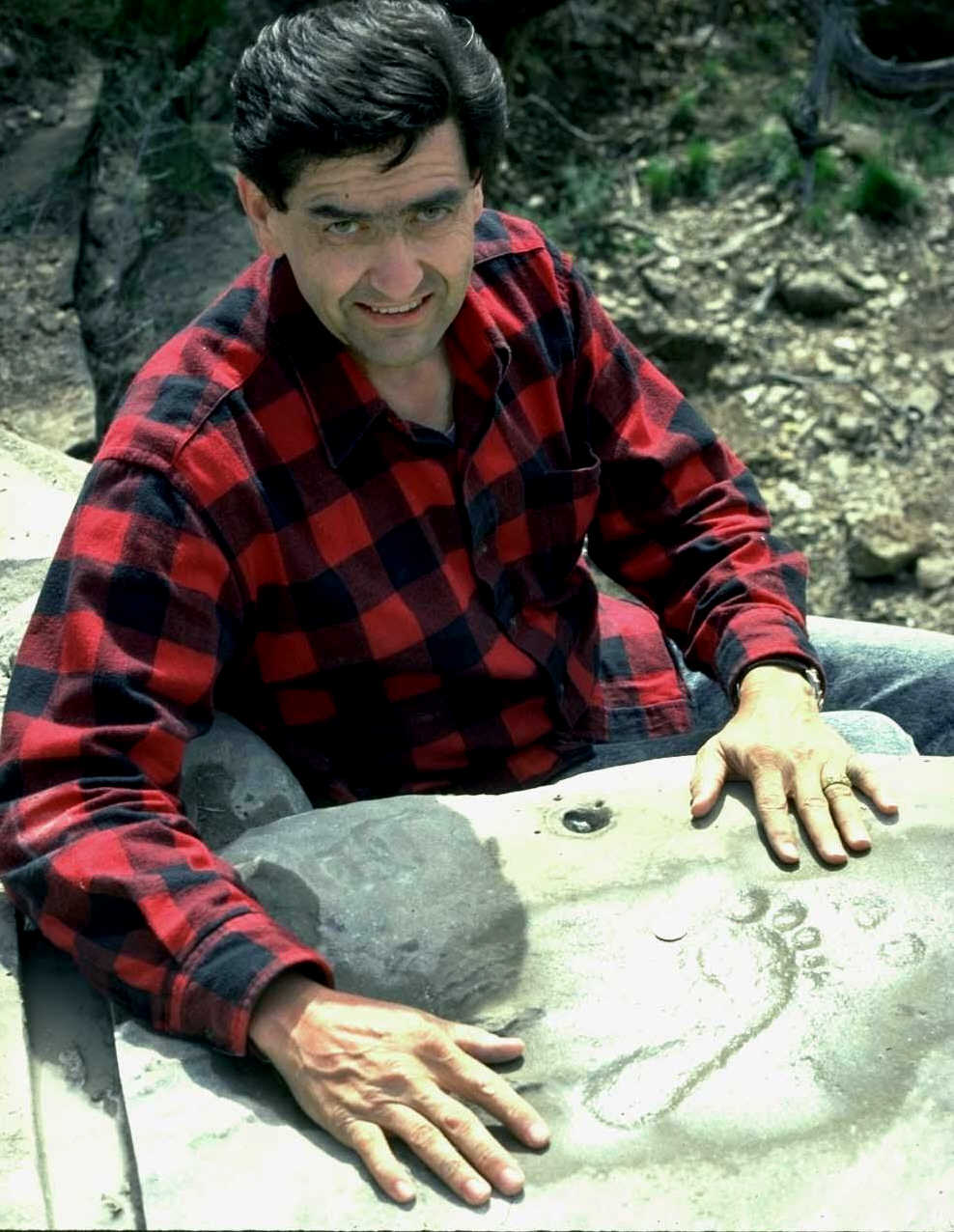
Discovery and Documentation of the Zapata Footprint
"In the book “Fossil Facts and Fantasies” by Joe Taylor, the footprint” appears to be a female, barefoot print.” Taylor states that it was found in 1929, and that “it is said that at that time, one half of a second track was visible at the edge of the ledge bearing both tracks. The edge of this ledge has since fallen off.” Taylor does not say where he learned these details, and does not cite any literature, scientific or popular, regarding it." -The Peoples Voice
The Zapata Footprint was reportedly rediscovered by a hunter in a remote area of New Mexico, who then informed his friend Don Shockey, an amateur archaeologist with a background in anthropology. Intrigued by the find, Shockey organized an investigative team that included Dr. Don Patton and Dr. Carl Baugh, both known for their interest in alternative history and creationist interpretations of ancient artifacts.
Armed with a mining permit, the team set out to document the footprint and examine the site. The footprint was photographed, cast impressions were made, and rock samples were taken for analysis. According to Dr. Patton, the footprint was faint and shallow, making it challenging to photograph.
Dr. Don Patton attempted to extract the Zapata footprint from the rock, but wore down four carborundum blades in the process, barely completing a single cut. Patton also reports seeing a photograph showing four nearly identical tracks in a clear right-left pattern located about a quarter mile from the Zapata footprint.
Further complications arose when an armed landowner claimed they were trespassing and demanded they leave, cutting short their examination. This interruption prevented the team from further documenting what was claimed to be a Permian-era human footprint, estimated to be over 250 million years old.
Claims and Controversy
According to Dr. Patton and Dr. Baugh, the Zapata Footprint appears to be a genuine human track embedded in limestone with a 30% silica content, consistent with Permian geological formations. Patton describes the footprint as shallow, with a slight "mud push-up" around the toes, indicating that the impression may have been made when the rock was still soft. However, critics and mainstream scientists have highlighted several inconsistencies and unanswered questions regarding the track’s origin and geological context.
Theories Surrounding the Zapata Footprint
As with many OOPArts, the Zapata Footprint has inspired various theories regarding its origins and implications. Here are the main perspectives that have been proposed:
1. Evidence of Ancient Human-Like Beings
Creationists and supporters of OOPArts argue that the Zapata Footprint is evidence of a human or human-like presence on Earth millions of years ago, challenging the established evolutionary timeline. This perspective aligns with a young Earth creationist view, suggesting that human-like beings may have lived alongside now-extinct species before a global catastrophe, such as the flood, radically altered Earth’s geology and fossil record.
2. Alternative Geological Timeline
Some advocates argue that the dating methods used to determine the age of geological layers are flawed or unreliable. According to this theory, rapid sedimentation processes or catastrophic events could explain why a human footprint would appear in rock layers typically assigned to the Permian period. This view questions the accuracy of mainstream dating techniques, proposing that footprints and other artifacts may have been fossilized in unexpectedly ancient rock layers.
3. Natural Erosion and Pareidolia
Mainstream scientists argue that the Zapata Footprint is likely a natural formation caused by erosion or other geological processes. In the erosion-prone environment of New Mexico, it’s possible for natural features to resemble recognizable shapes, such as human footprints, through a phenomenon called pareidolia, where random patterns are perceived as familiar forms. The vague outline and lack of anatomical detail support the idea that the Zapata Footprint is simply a coincidental formation in rock.
4. Possible Hoax or Enhancement
Given the rarity of genuine fossilized human tracks in ancient rock, some skeptics believe that the Zapata Footprint could have been altered or enhanced to resemble a footprint more closely. Similar claims in the past have been found to involve modern modifications to natural impressions, creating shapes that resemble footprints. Without a complete geological and paleontological study, suspicions of alteration or enhancement remain unresolved.

Scientific Examination and Skepticism
The Zapata Footprint has not been subjected to a formal peer-reviewed study, limiting its acceptance in the scientific community. The few analyses that do exist raise concerns over the footprint’s authenticity:
Geological Context
Mainstream geologists note that if the Zapata Footprint were a genuine human print, it would represent an extraordinary anomaly in Earth’s history. The Permian period, from which the limestone reportedly originates, predates not only humans but also dinosaurs by millions of years. Without a verified context linking the print to this ancient formation, the footprint’s value as evidence of ancient humans is questionable.
Anatomical Inconsistencies
Dr. Patton has described the footprint as “spectacular,” yet some researchers note that its features, such as the toe alignment and ball of the foot, appear unnatural compared to a genuine human print. This lack of realistic anatomical detail, along with the shallow depth, calls into question its authenticity as a true fossilized footprint.
Absence of a Fossil Trackway
A solitary footprint without a sequence or additional prints lacks the context that could support its authenticity. In contrast, genuine fossilized human footprints, such as the Laetoli tracks in Tanzania, are part of a continuous trackway that confirms their origin. Since the Zapata Footprint lacks this context, it is harder to establish as evidence of human presence.
Limited Creationist Support
Surprisingly, despite Patton and Baugh’s claims, the Zapata Footprint has not been widely endorsed by major creationist organizations. Groups like Answers in Genesis and other leading creationist bodies have not accepted the print as reliable evidence, with many creationists themselves dismissing it due to the lack of supporting context and verification.