
Willett Footprint: Difference between revisions
No edit summary |
|||
| Line 18: | Line 18: | ||
| Unknown | | Unknown | ||
|} | |} | ||
== The Willett Footprint: A Mysterious Mark in the Bedrock == | == The Willett Footprint: A Mysterious Mark in the Bedrock == | ||
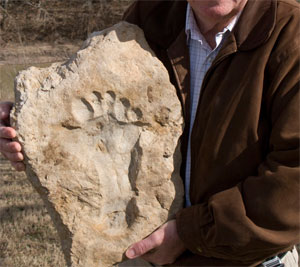
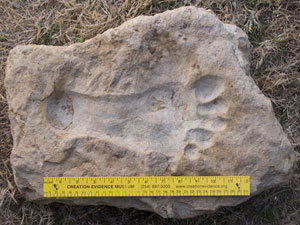
The Willett Footprint is a controversial fossil-like impression discovered in Berea Sandstone near Berea, Kentucky, by Mr. Alfred Willett in the early 20th century. It appears to be a human footprint embedded in rock dated to around 320 million years ago, a period known as the Carboniferous, long before any known primates, let alone humans, are thought to have existed. Due to its seeming anachronism, the Willett Footprint has fascinated proponents of alternative history and sparked debate, though mainstream scientists are generally skeptical of its authenticity as a true human footprint. | The Willett Footprint is a controversial fossil-like impression discovered in Berea Sandstone near Berea, Kentucky, by Mr. Alfred Willett in the early 20th century. It appears to be a human footprint embedded in rock dated to around 320 million years ago, a period known as the Carboniferous, long before any known primates, let alone humans, are thought to have existed. Due to its seeming anachronism, the Willett Footprint has fascinated proponents of alternative history and sparked debate, though mainstream scientists are generally skeptical of its authenticity as a true human footprint. | ||
{| | |||
| <https://www.footprintsinstone.com/wp-content/uploads/2013/12/willett-print-2.jpg> | |||
|- | |||
| Willett Footprint - Footprints in Stone Website | |||
|} | |||
{| | |||
| <https://www.footprintsinstone.com/wp-content/uploads/2013/12/willett-print-3.jpg> | |||
|- | |||
| Willett Footprint - Footprints in Stone Website | |||
|} | |||
== The Discovery of the Willett Footprint == | == The Discovery of the Willett Footprint == | ||
Alfred Willett, a local Kentucky resident, reportedly discovered the unusual mark while exploring sandstone rock formations near Berea. The impression appeared to resemble a human footprint, complete with visible toes, an arch, and a heel. The footprint was estimated to measure about nine inches in length, similar to the size of a modern human foot. Intrigued, Willett brought attention to the find, which quickly captured the interest of both amateur archaeologists and those questioning traditional timelines of human evolution. | Alfred Willett, a local Kentucky resident, reportedly discovered the unusual mark while exploring sandstone rock formations near Berea. The impression appeared to resemble a human footprint, complete with visible toes, an arch, and a heel. The footprint was estimated to measure about nine inches in length, similar to the size of a modern human foot. Intrigued, Willett brought attention to the find, which quickly captured the interest of both amateur archaeologists and those questioning traditional timelines of human evolution. | ||
| Line 31: | Line 41: | ||
=== 1. Natural Erosion and Pareidolia === | === 1. Natural Erosion and Pareidolia === | ||
The mainstream scientific explanation is that the Willett Footprint is not a footprint at all but a natural formation caused by erosion or other geological processes. Weathering and erosion in sandstone can create patterns that resemble familiar shapes, including human footprints. Scientists argue that what looks like a footprint is likely a case of pareidolia—the tendency to perceive recognizable forms in random patterns. This explanation suggests that the supposed toe and arch marks are coincidental indentations formed by environmental factors over millions of years. | The mainstream scientific explanation is that the Willett Footprint is not a footprint at all but a natural formation caused by erosion or other geological processes. Weathering and erosion in sandstone can create patterns that resemble familiar shapes, including human footprints. Scientists argue that what looks like a footprint is likely a case of pareidolia—the tendency to perceive recognizable forms in random patterns. This explanation suggests that the supposed toe and arch marks are coincidental indentations formed by environmental factors over millions of years. | ||
Revision as of 04:38, 3 November 2024
Quick Facts
| Location Found: | Dinosaur Valley State Park |
| Discovery Date: | 1950's |
| Current Location: | Creation Evidence Museum of Texas |
| Authenticity: | Confirmed |
| Open to the Public: | Unknown |
The Willett Footprint: A Mysterious Mark in the Bedrock
The Willett Footprint is a controversial fossil-like impression discovered in Berea Sandstone near Berea, Kentucky, by Mr. Alfred Willett in the early 20th century. It appears to be a human footprint embedded in rock dated to around 320 million years ago, a period known as the Carboniferous, long before any known primates, let alone humans, are thought to have existed. Due to its seeming anachronism, the Willett Footprint has fascinated proponents of alternative history and sparked debate, though mainstream scientists are generally skeptical of its authenticity as a true human footprint.
< > >
|
| Willett Footprint - Footprints in Stone Website |
< > >
|
| Willett Footprint - Footprints in Stone Website |
The Discovery of the Willett Footprint
Alfred Willett, a local Kentucky resident, reportedly discovered the unusual mark while exploring sandstone rock formations near Berea. The impression appeared to resemble a human footprint, complete with visible toes, an arch, and a heel. The footprint was estimated to measure about nine inches in length, similar to the size of a modern human foot. Intrigued, Willett brought attention to the find, which quickly captured the interest of both amateur archaeologists and those questioning traditional timelines of human evolution.
The Berea Sandstone in which the footprint was found dates back to the Carboniferous period, approximately 320 million years ago. This period was characterized by dense forests, swamps, and the emergence of giant insects and amphibians, long before the evolution of mammals, let alone humans. The Willett Footprint thus raised significant questions: if authentic, it would drastically alter our understanding of human history and the timeline of evolution on Earth.
Theories Surrounding the Willett Footprint
The Willett Footprint has inspired a variety of interpretations, from mainstream scientific explanations to alternative theories suggesting lost civilizations or out-of-place artifacts (OOPArts). Here are some of the leading theories:
1. Natural Erosion and Pareidolia
The mainstream scientific explanation is that the Willett Footprint is not a footprint at all but a natural formation caused by erosion or other geological processes. Weathering and erosion in sandstone can create patterns that resemble familiar shapes, including human footprints. Scientists argue that what looks like a footprint is likely a case of pareidolia—the tendency to perceive recognizable forms in random patterns. This explanation suggests that the supposed toe and arch marks are coincidental indentations formed by environmental factors over millions of years.
2. Ancient Hominid or Human-Like Species
A more controversial interpretation suggests that the Willett Footprint could belong to a previously unknown human-like species or early hominid that somehow existed in the Carboniferous period. This theory aligns with fringe ideas of ancient civilizations and alternative timelines, which propose that humanity’s history extends far further back than conventional science allows. Proponents of this view argue that the footprint represents an out-of-place artifact (OOPArt) that challenges mainstream geological and evolutionary timelines.
3. Extraterrestrial or Non-Human Origin
Some alternative theorists propose that the footprint was left by extraterrestrial beings who visited Earth in ancient times, or by an unknown species with human-like features that predates Homo sapiens. This theory aligns with the ancient astronaut hypothesis, which suggests that extraterrestrial life has influenced or interacted with Earth’s inhabitants for thousands or even millions of years. However, there is no scientific evidence supporting this claim, and it remains speculative.
Scientific Scrutiny and Skepticism
Mainstream scientists have generally dismissed the Willett Footprint as a misinterpretation, arguing that the supposed footprint is the result of natural processes. Geologists and paleontologists point out that the Carboniferous period is simply too old to contain human or even mammalian remains, as life on Earth at that time consisted primarily of fish, amphibians, and primitive plants.
Several key factors have fueled skepticism surrounding the Willett Footprint:
- Geological Age Incompatibility
- The Carboniferous period predates not only humans but also mammals by hundreds of millions of years. For the footprint to be genuine, it would require a complete overhaul of the current understanding of evolution and the development of life on Earth.
- Absence of Peer-Reviewed Studies
- The Willett Footprint has not been subjected to rigorous scientific testing or published in any reputable, peer-reviewed journals. Without verification and analysis by experts, claims surrounding the footprint cannot be validated within the scientific community.
- Lack of Corroborating Evidence
- There are no other documented human or human-like artifacts or fossils from the Carboniferous period, and the Willett Footprint is an isolated find. Scientists argue that if humans or human-like beings had existed 320 million years ago, there would be additional evidence in the fossil record.
- Possible Cases of Pareidolia
- The footprint’s features are vague and indistinct, with no clear separation of toe marks or definitive arch structure. The irregularities in the shape support the theory that it is simply an unusual formation caused by natural forces rather than a true fossilized footprint.
The Cultural Impact and Legacy of the Willett Footprint
Despite its lack of acceptance among mainstream scientists, the Willett Footprint continues to captivate those who question conventional histories. The footprint has been featured in various books and articles on forbidden archaeology, alternative history, and mysterious artifacts. Proponents of ancient advanced civilizations and out-of-place artifacts often cite the Willett Footprint as a potential example of hidden or overlooked chapters of human history.
For fringe archaeologists and enthusiasts, the footprint represents a symbol of humanity’s possible forgotten past, suggesting that there may be much about Earth’s history that remains unknown. Though the footprint has not been scientifically validated, it fuels interest in the idea that Earth’s history may be more complex and that modern humans may not have been the first intelligent beings to walk the planet.
A Geological Curiosity or Evidence of the Unknown?
The Willett Footprint remains an enigma, not because of its scientific merit but because of the debate it sparks over the nature of historical evidence and interpretation. For most scientists, it is a natural rock formation misinterpreted as a footprint, lacking the necessary characteristics and context to be considered authentic evidence of ancient human presence. For others, however, the Willett Footprint raises questions about the assumptions underlying our understanding of human origins and geological time.
While the footprint is unlikely to alter the course of archaeological or geological research, it serves as a reminder of the human tendency to seek patterns and meaning in the unknown. Whether it is simply a curiosity of nature or a symbol of humanity’s hidden past, the Willett Footprint will likely continue to inspire debate, encouraging open-minded inquiry while underscoring the importance of rigorous scientific analysis.